What Portugal searched for on 23 September 2026
Most searched in the 24 hours to 10:20: previsão (20K+), horário de inverno (20K+), frente fria (10K+), greve (5K+), greve 2 outubro 2026 (5K+), notas de euro (5K+).
-
previsão20K+ searchesPublished 5 November 2026, 06:07
Previsão is Portuguese for “forecast”, and people are checking the weather for good reason. On the third day of autumn, IPMA has a yellow heat warning in place (“maximum temperatures remain high”) in nine mainland districts and across all of Madeira. For Lisbon, Santarém and Viseu it runs until 18:00 on Wednesday; for Bragança, Vila Real, Guarda, Castelo Branco, Portalegre and Évora, until 18:00 on Thursday; and for four areas of Madeira, from Thursday morning to Friday evening.
In degrees, IPMA’s forecast for today is: Évora 38.6°, Santarém 37.9°, Beja 37.1°, Castelo Branco 36.7°, Lisbon 35.9°, Portalegre 35.6°, Braga 35.2°. On the northern coast it is cool on the same day: Aveiro 21.2°, Porto 26.1°. That is a gap of more than seventeen degrees between two parts of the country, which is quite normal for Portugal. Tomorrow the heat inland and in the south will barely ease: 37.7° in Évora, 36.5° in Castelo Branco, 34.8° in Lisbon.
Yellow is the lowest level at which IPMA issues a warning at all, and it asks little of you: drink water, stay out of the sun between 11:00 and 17:00, avoid strenuous work during those hours, and keep an eye on older people and young children. What matters more is that dry heat combined with warm nights keeps the wildfire risk high. Today 85 of the mainland’s 278 municipalities are at maximum risk and another 128 at very high risk. Civil protection (Proteção Civil) is on level-three alert, and on days of very high and maximum risk, burning piles of branches and garden waste on your land is banned. What to do if a fire is close and how the risk levels work are explained in our guide Heat and wildfires in Portugal; the forecast by district for today and the next five days is on our page /weather/.
Source: ipma.pt
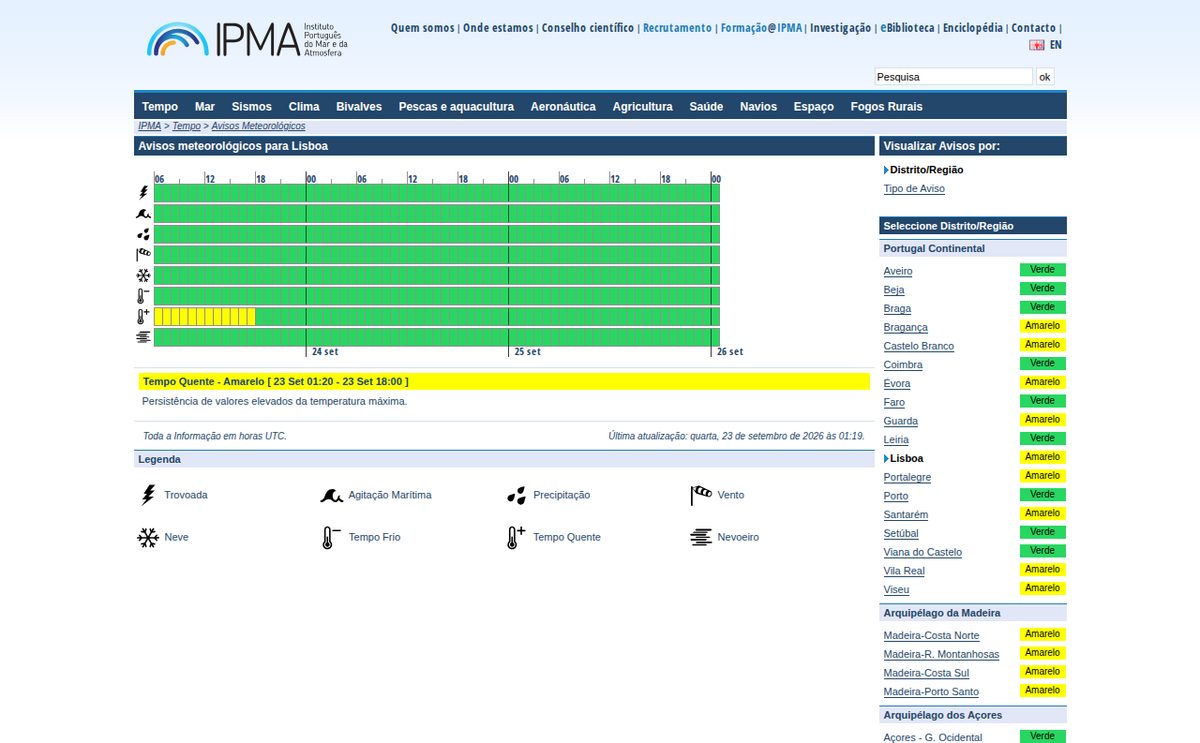
IPMA warnings for 23 September: yellow heat level in nine districts and on Madeira, ipma.pt, screenshot of the website -
horário de inverno20K+ searchesPublished 5 November 2026, 06:07
Winter time. In the early hours of Sunday 25 October, Portugal puts its clocks back: on the mainland and Madeira they go from 02:00 to 01:00, and in the Azores from 01:00 to 00:00. You get an extra hour in bed that night, and it will start getting dark at around five in the evening. The first thing that catches out people from countries that scrapped the change long ago is the time difference: with Moscow, for example, it becomes three hours instead of two, so calls with family will need to be rescheduled. The change is not Lisbon’s decision: it rests on EU Directive 2000/84/EC, and the European Commission sets the exact dates five years ahead. The calendar published on 18 March 2026 runs to 2031, and in 2027 the dates are 28 March and 31 October. So claims that “this is the last change” are wrong: scrapping the seasonal clock change in the EU has been under discussion since 2018, and there is still no agreed decision. Nothing happened today to prompt the searches: the change is still a month away and people are planning ahead.
Source: eur-lex.europa.eu
-
greve5K+ searchesPublished 5 November 2026, 06:07
The Portuguese word “greve” means strike. The next one to affect people directly is on 9 October: the STSS union has called a nationwide strike of diagnostic and therapy technicians in the public health service, meaning testing laboratories, X-rays and other scans, and physiotherapy. The dispute is over the revised pay scale: the union says that in moving to the new scale, staff lose the points they have built up, and people can end up ahead of colleagues regardless of length of service. On the same day a protest is planned outside the Ministry of Health, and from the end of September and throughout October the union promises separate strikes in local health units (ULS); if there is no response, there will be another two-day strike at the end of November. What this means for you: tests, scans or physiotherapy booked for 9 October may be postponed. Minimum services for that day will still be set, so until they are announced there is no need to ring up and cancel your appointment.
There is also a strike in the air: easyJet cabin crew are striking on 2–6 October and 19–23 December, affecting around 500 October flights from Lisbon, Porto and Faro. We covered it on 17 September in easyJet cabin crew strike on 2–6 October and 19–23 December: if you have already bought a ticket, wait for the airline’s email, and if your flight is cancelled, choose between a refund and an alternative flight. The ambulance strike on 14 and 28 September, however, was called off; we covered that too: Ambulance strike on 14 and 28 September called off.
You can check for yourself whether a strike is planned for the day you need: all strikes are registered in advance and listed by DGERT, the labour relations directorate, at Pré-avisos de greve. A strike notice does not mean the strike will go ahead: strikes are often called off after talks, as happened with the ambulances.
Source: rtp.pt
-
greve 2 outubro 20265K+ searchesPublished 5 November 2026, 06:07
The strike on 2 October. Three unions affiliated to CGTP — FNSTFPS, STAL and STML — have called a nationwide strike on Friday 2 October of the so-called carreiras gerais: operational and technical assistants and specialists, around 350,000 people working in ministries and public agencies, in municipalities and on the islands. They want pay talks to start now rather than in 2027; STML is demanding, among other things, a 15% rise of no less than €150 per person. What this means for newcomers: on 2 October public offices may not open, rubbish collection may stop and schools may close. In schools these staff run the canteens, do the cleaning and look after the children, and on 23 September head teachers told the press they expect a high turnout. In Lisbon there is a march at 11:00 from Praça da Figueira to the Ministry of Finance, and the centre will be closed to traffic. The level of minimum services (serviços mínimos) is announced only in the last few days before the strike, so if you have an appointment on 2 October, check again the day before. The same day, a five-day strike by easyJet cabin crew begins; we covered it separately: easyJet cabin crew strike on 2–6 October and 19–23 December.
Source: stml.pt
-
frente fria10K+ searchesPublished 5 November 2026, 06:07
Cold front: not yet. On 23 September IPMA has a yellow heat warning in place for nine mainland districts and, from Thursday, Madeira (more on that above, under the search previsão), and the official forecast shows no rain on any of the next five days. The talk of a front comes from forecasters, not from warnings: Atlantic air and cloud are expected from 24 September, but a change in the weather with rain is not expected before 29 September. It is worth checking the primary sources: IPMA warnings and our weather page, where the forecast by district is updated every hour.
Source: ipma.pt
-
notas de euro5K+ searchesPublished 5 November 2026, 06:07
Euro banknotes: today the ECB said that almost 10 million people took part in its survey on the design of future banknotes. The ECB Governing Council will make the final choice by the end of 2026, and printing and issuing the new notes will not start until the 2030s. The current banknotes remain legal tender with no expiry date and will circulate alongside the new ones, so you will not need to exchange them; any calls urging you to “exchange your old euros urgently” are a scam.
Source: ecb.europa.eu
-
terremoto2K+ searchesPublished 5 November 2026, 06:07
The word “terremoto” means earthquake. Today, 23 September, there has not been a single tremor in Portugal strong enough to be felt: by midday IPMA had recorded five, the strongest of them, of magnitude 0.8, were near Melgaço and in the Gulf of Cádiz, which nobody would notice. People are searching because of yesterday: on 22 September at 15:04, eight kilometres east of Cadaval in the Lisbon district, there was a magnitude 2.7 tremor at a depth of two kilometres. That is IV on the Mercalli scale, the level at which windows and dishes rattle. No one was hurt and there was no damage.
Source: ipma.pt
